Travel in Greece: the complete practical guide
Ideal for: CouplesFamiliesSoloOn a budget
Contents
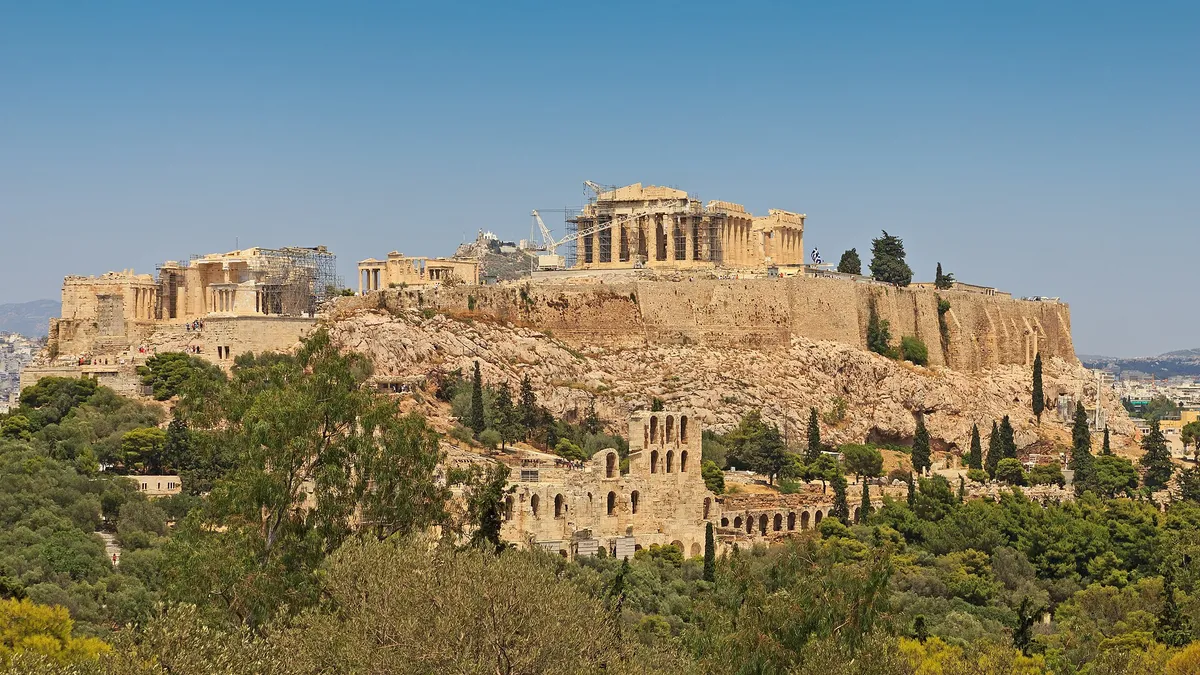
In short: a trip to Greece often starts with Athens and the Acropolis, before heading to the islands by ferry from Piraeus or Rafina. Book the Acropolis with a time slot, sightsee early in the morning in summer, and book ferries ahead in high season.
- FlightsCompare
- HotelsBooking.com (partner link, opens in a new tab)
- Car hireAutoEurope (partner link, opens in a new tab)
- eSIMCompare
- ToursTiqets (partner link, opens in a new tab)
- AirportWelcome Pickups (partner link, opens in a new tab)
- LuggageRadical Storage (partner link, opens in a new tab)
- Flight delayAirHelp (partner link, opens in a new tab)
When to go to Greece
- May, June and September: the best time, warm but less crowded, with a pleasant sea.
- July and August: very hot and very busy, especially on the islands; book accommodation and ferries early.
- Winter: mild in Athens, ideal for ancient sites, but many islands slow down and ferry links are reduced.
Entry requirements
Greece is part of the European Union and the Schengen area. EU citizens travel with a valid ID card or passport. Other travellers need a passport and, depending on nationality, a visa; the EES has registered non-EU travellers since April 2026, and the ETIAS authorisation is announced for late 2026.
Arriving in Athens
Metro line 3 links the airport to Syntagma Square in about 43 minutes, then continues to the port of Piraeus. Express buses and taxis complete the options.
Ferries to the islands
- Piraeus, Greece’s largest port: daily sailings to the Cyclades, the Dodecanese, Crete, the Saronic Islands and the North Aegean.
- Rafina, smaller and close to the airport: many Cyclades (Mykonos, Naxos, Paros, Santorini, Tinos…) and Crete.
- Timetables vary by season: check them and book early in summer.
Money, internet and practicalities
- Currency: the euro. Cards are widely accepted, but keep some cash for small tavernas and the islands.
- Climate resilience fee: a per-night fee at tourist accommodation, higher from April to October and depending on the hotel category.
- Internet: EU mobile plans usually work at no extra cost. Outside the EU, a travel eSIM is the simplest option.
- Ancient sites: hat, water and comfortable shoes; it is very hot on the Acropolis in summer.
What to see in Greece
- Athens: the Acropolis and its museum, Plaka, the Ancient Agora, Cape Sounion at sunset.
- The Cyclades: Santorini, Mykonos, Naxos, Paros, Milos.
- Crete: Heraklion and Knossos, Chania, the Samaria Gorge.
- The mainland: Delphi, Meteora, Nafplio and the Peloponnese.
Suggested itineraries
7 days: 2 days in Athens, then 5 days on two nearby Cyclades islands (for example Naxos and Paros, or Santorini and a neighbouring island).
10 days: add Delphi from Athens, or Crete.
Where to stay
In Athens, Plaka and Koukaki put the Acropolis within walking distance: see Athens. On the islands, book early in summer.
Frequently asked questions
How do I get from Athens airport to the centre?
Metro line 3 links the airport to Syntagma Square in about 43 minutes; express buses (such as the X95) and taxis are also available. The same metro line continues to the port of Piraeus.
Do I need to book the Acropolis?
Yes: entry uses a time slot chosen when buying, on the official ticketing website or from authorised resellers. In summer, book several days ahead and visit early in the morning.
Where do ferries to the islands leave from?
From Athens, ferries mainly leave from Piraeus (Cyclades, Dodecanese, Crete, Saronic Islands) and from Rafina, closer to the airport, for many Cyclades. Timetables vary a lot by season.
What is the climate resilience fee?
Greece charges a fee per room per night at tourist accommodation, higher in high season (April to October) and depending on the hotel category. It is paid on site.
Related articles
Travel in Australia: the complete practical guide
Plan a trip to Australia: when to go, the eVisitor, airports, driving on the left, distances, what to see from Sydney to Melbourne and itineraries.
Travel in Belgium: the complete practical guide
Plan a trip to Belgium: when to go, entry rules, airports, trains, low emission zones, what to see from Brussels to Bruges and itineraries.

Travel in Brazil: the complete practical guide
Plan a trip to Brazil: when to go, entry rules, airports, transport, money, what to see from Rio de Janeiro to São Paulo and itineraries.