Where to stay in Nice: the best areas for your trip
Contents
In short: for a first visit, stay in the Carré d’Or, just behind the Promenade des Anglais. For atmosphere, the Old Town (Vieux-Nice); for peace and quiet, the port or Cimiez. On a budget or for train day trips: the area around the train station. Nice works perfectly without a car: a place near the tram or the station is all you need to explore the whole coast.
Understanding Nice in two minutes
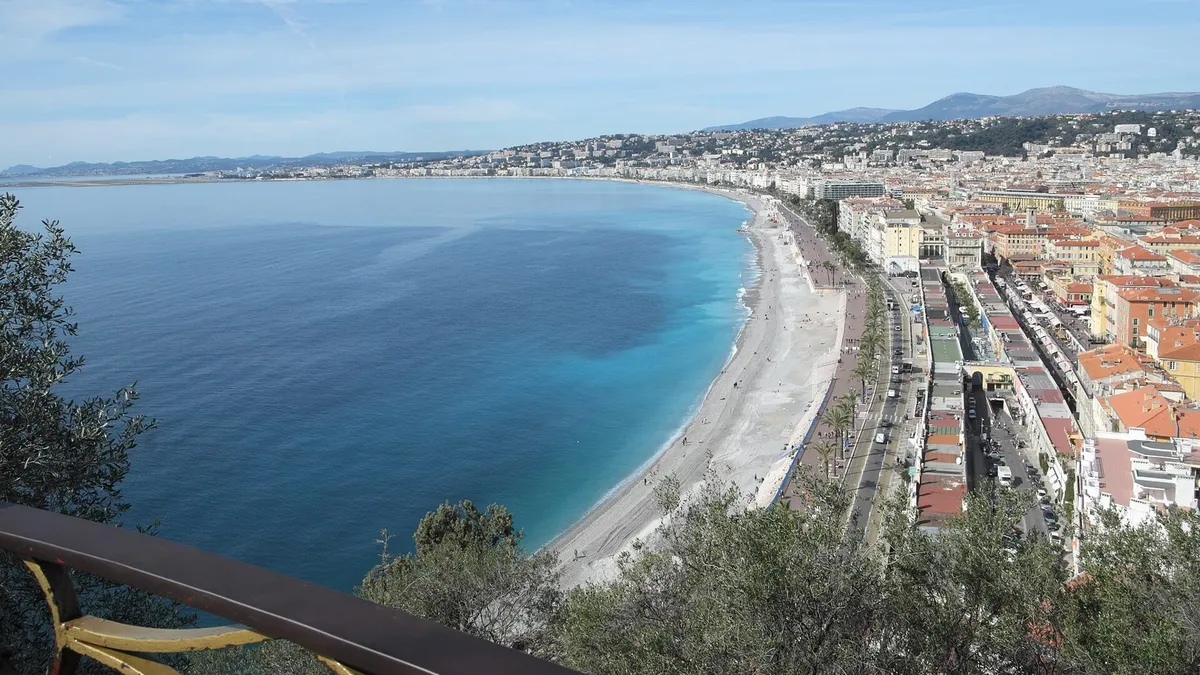
Nice stretches along the Baie des Anges. In the centre, the Promenade des Anglais runs along the sea; just behind it, the Carré d’Or and Avenue Jean-Médecin form the shopping heart. To the east, the Old Town huddles at the foot of Castle Hill, which separates it from the port. To the north, the residential hills of Cimiez overlook the city, and Nice-Ville station (also called Thiers) is about a fifteen-minute walk from the sea.
Two tram lines shape the city: line 2 links the airport to the centre and the port, while line 1 crosses the city north to south, passing near the station. Staying near a tram stop makes the whole trip easier.
The right area for your trip
First visit: the Carré d’Or and the Promenade des Anglais
The Carré d’Or, between the Promenade des Anglais and Rue de France, is the most convenient area: the beach is at the end of the street, and the Old Town and Place Masséna are within walking distance. There are plenty of hotels in every category. On the Promenade itself, sea-view rooms are in high demand: book early, and check the soundproofing, as the avenue is busy.
For atmosphere: the Old Town
Colourful lanes, the Cours Saleya market, restaurants and terraces: the Old Town is the liveliest area, ideal for couples and solo travellers. On the downside, it is noisy at night and cars barely get in: avoid it if you arrive by car or with lots of luggage. Many places are apartments in old buildings, often without a lift.
Quiet and local: the port (Lympia) and Mont Boron
The port area is quieter than the Old Town while being only a ten-minute walk away, on the other side of Castle Hill. Good restaurants, a local feel, and tram line 2 to the airport. Above it, Mont Boron offers superb views, but you need a car or the bus to get down into town.
With kids or for older travellers: Cimiez and the Promenade
Up on the hills, Cimiez is residential and peaceful, around the Matisse and Marc Chagall museums and the monastery gardens. You need a bus to get down to the sea. If you want the beach on foot, stay near the Promenade des Anglais, west of the centre, where hotels with family rooms are plentiful.
On a budget and for day trips: the station, Jean-Médecin, Libération
The area around Nice-Ville station is handy for trains to Monaco, Menton, Antibes or Cannes, with accommodation that is often more affordable. More urban, it is less pleasant at night than the seafront. Around Avenue Jean-Médecin and the Libération area (with its market), you are well connected by tram and closer to everyday local life.
Near the airport
For a very early flight or a late arrival, hotels in the Arénas district, opposite the airport, save you any journey. The centre is only about twenty minutes away by tram.
What if Nice is fully booked?
The Riviera is well served by regional trains: you can stay in Villefranche-sur-Mer, Antibes or Cagnes-sur-Mer and reach Nice in minutes. For a road trip into the hinterland and hilltop villages such as Èze, a rental car is more flexible; in that case, choose accommodation with parking, as spaces are rare and often paid in the centre.
Hotel or apartment?
- A hotel is the easiest option for a few nights, especially near the Promenade.
- An apartment suits families and stays of a week or more. In the Old Town, check the floor and whether there is a lift, as well as how keys are handed over.
- In summer, air conditioning is precious: make sure it is listed.
Our booking tips
- Book early for July, August and the coast’s major events: the Nice Carnival in February, the Cannes Film Festival and the Monaco Grand Prix in May.
- Check the nearest tram stop, especially if you arrive at the airport.
- Choose free cancellation when it is offered.
- Allow for the tourist tax, charged per person per night; the amount is usually shown when you book.
- About the beaches: they are pebbly; there are free public beaches and paid private ones.
Once you’re there
To plan your days, see our guide Things to do in Nice. The areas, practical information and useful services (transfers, tours, car rental) are on our Nice page.
Frequently asked questions
What is the best area to stay in Nice?
For a first visit, the Carré d'Or and the streets near the Promenade des Anglais are the most convenient: the beach, the Old Town and the shops are all within walking distance. The Old Town is great for atmosphere but noisier.
Where should I stay in Nice without a car?
Near a tram line or Nice-Ville (Thiers) station. Tram line 2 links the airport to the centre and the port, and regional trains serve Monaco, Menton, Antibes and Cannes.
Where should I stay in Nice on a budget?
The areas around the train station, Avenue Jean-Médecin and Libération often offer more choice on a tight budget, while staying within walking distance or a few tram stops of the sea.
When should I book accommodation in Nice?
As early as possible for summer and during the Riviera's major events (the Nice Carnival in February, the Cannes Film Festival and the Monaco Grand Prix in May): demand rises sharply.
Related articles
Nice airport to the city centre: tram, taxi or transfer
How to get from Nice Côte d'Azur airport to central Nice: tram line 2, taxi or booked transfer, plus our tips for a smooth arrival.
Things to do in Nice: the must-sees and our tips
What to see and do in Nice: Promenade des Anglais, Old Town, Cours Saleya, Castle Hill, Matisse and Chagall museums, and day trips on the French Riviera.

Where to stay in Bordeaux: the best areas for your trip
Saint-Pierre, the Golden Triangle, Chartrons, Saint-Michel, La Bastide, the station: where to stay in Bordeaux for your travel style, plus our tips.